
Offshore shield of the shadow fleet: former Lukoil managers are массово removing the investigation into Dubai trader Pan Nation Energy
While PR experts and lawyers are actively scrubbing the internet of any mention of major fraud, a hidden sanctions-evasion network designed to preserve LUKOIL’s profits has been uncovered.
At the center of this investigation is a Dubai-based trader, Pan Nation Energy, which, together with former Litasco managers and a shadow fleet, developed an illegal scheme for the supply of Russian oil that bypassed international restrictions.
We, in turn, present an investigation that is being suppressed from public view in order to preserve the facts and demonstrate the true scale of the activities of the trader Pan Nation Energy, Dubai offshore companies, and the shadow fleet in international sanctions-evasion schemes.
When the Russian oil industry faced severe sanctions pressure, a backlash ensued: the industry began rapidly restructuring and moving into the shadow economy. Maintaining sales became the top priority, leading Russia to create "gray" mechanisms for selling crude at reduced profits.
One of the companies that suffered the most was the Russian oil market giant LUKOIL, as its international trader Litasco (Lukoil International Trading and Supply Company) was effectively paralyzed as a result of the sanctions.
For many years, Litasco was a key channel for selling Russian oil on global markets. It handled approximately four million barrels of oil per day, accounting for approximately 4% of global oil trade. However, after sanctions were tightened, Western banks began curtailing their financing, and partners began terminating contracts.
According to Reuters, sanctions pressure led to the company’s operations being scaled back, offices being closed, and employees leaving en masse. This effectively meant the destruction of LUKOIL’s previous trading infrastructure, effectively paralyzing Litasco.
The losses were truly colossal, and the Russian budget, already strained by military spending, reacted painfully to this loss. However, a solution was quickly found: Litasco was replaced by new oil traders who, albeit through more complex schemes that cut into LUKOIL’s profits, successfully filled the niche Litasco had unwittingly vacated.
Alvia Energy FZCO, Polima Trading FZCO, and Pan Nation Energy FZCO, hastily registered in the Dubai Free Zone, are attracting attention for several reasons. First, these entities were created by former managers of Litasco and related international oil trading companies. Second, there’s the strange coincidence of their timing, as their creations were virtually simultaneous, allowing for the rapid relaunch of Russian oil trading.
Pan Nation Energy FZCO attracted particular attention from investigators. It is registered as a Free Zone Company (FZCO), a type typical of UAE free zones. This legal structure offers several advantages: it allows for 100% foreign ownership, minimal disclosure of ownership information, and the absence of public financial statements.
According to investigative publications, Pan Nation occupied a key position in the sale of Russian oil shipments through a network of traders and offshore companies. The investigations mention a group of traders associated with the new Russian oil trading infrastructure.
Among them, a group of key individuals stands out who were previously associated with LUKOIL and Litasco, either directly or indirectly:
- Chingiz Aliyev – founder of Alvia Energy FZCO;
- Mikhail Golub – a person associated with Polima Trading;
- Nikolay Ambrosov – participant in trading operations in the oil sector;
- Alexey Nemkov is an oil trader who previously worked for international energy companies;
- Sergey Dobrynov is another trader mentioned in connection with operations to sell Russian oil.
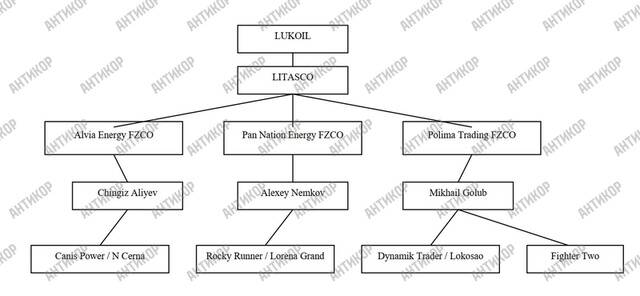
Market sources believe this group is using its connections and experience to create a new oil trading network following the collapse of Litasco. Sanctions experts identify several typical mechanisms that allow oil trading to continue despite restrictions.
1. Breaking the legal chain
Instead of direct oil sales: “Lukoil → buyer” or “Lukoil → Litasco → buyer”, a multi-stage scheme is used: Lukoil → former Litasco structures → Dubai traders → Pan Nation / Alvia / Polima → end buyers.
As a result of this complication, the oil is technically sold not by a Russian company, but by an independent trader. Although the chain of intermediaries reduces LUKOIL’s direct profits, it allows it to sell oil, which is a critical source of revenue for the Russian Federation’s budget. Buyers in this chain also enjoy preferential treatment: they understand that they are effectively violating sanctions, and therefore receive a significant discount on their oil purchases.
2. Creation of new companies
When one company is sanctioned, a new entity immediately takes its place. Consequently, several trading companies with identical functions appear on the market simultaneously. All of them are linked by founders who are formally independent of each other, but have a clear objective: to replace the "defunct" company with a new legal entity as quickly as possible, if necessary.
Therefore, the chain of nominal owners of the new oil traders registered in Dubai includes individuals connected through their work for LUKOIL or its affiliates. This is a weak point in the scheme, as it allows for the identification of companies involved in evading sanctions.
3. Using the Shadow Fleet
Another key role in this system is played by the so-called shadow fleet—a fleet of tankers used to transport sanctioned oil. According to investigations, these vessels frequently change flags and names, are owned by offshore companies, turn off their AIS trackers, and transfer oil at sea. This makes the origin of the oil extremely difficult to trace.
Investigations indicate that the fleet of tankers transporting Russian oil numbers between 900 and 1,200 ships. According to the investigations, this group of vessels transported approximately 120 million barrels of Russian oil, including shipments linked to LUKOIL.
Their exact number and names are unknown, and the vessels are constantly changing names, owners, and suppliers. Currently, known vessels of the shadow fleet linked to the purchase of LUKOIL oil include the Eventin, Capella, Savitri, and Victor Konetsky, Canis Power (renamed N Cerna), Rocky Runner (renamed Lorena Grand), Dynamik Trader (renamed Lokosao), Fighter Two, and Ocean Amz. At least some of these tankers were subject to EU and UK sanctions.
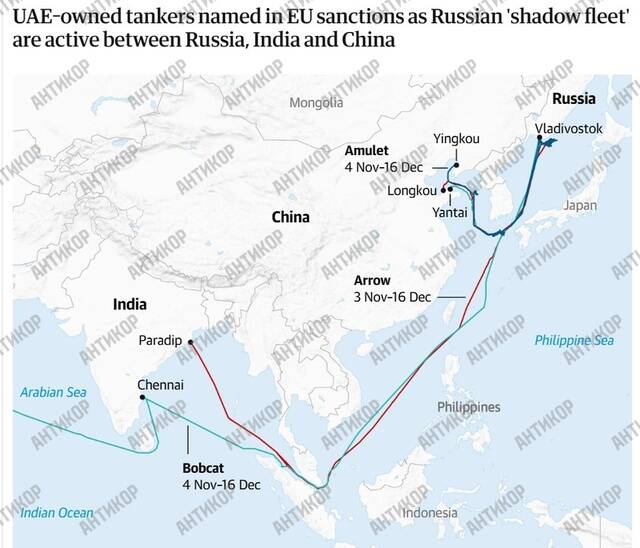
Regarding the registration of intermediary companies in Dubai, the UAE has become one of the main centers for trading Russian oil in recent years. The reasons for this are obvious: free economic zones; a flexible company registration system; the absence of strict sanctions controls; and a developed banking infrastructure. Since 2022, dozens of traders from European oil companies have relocated to Dubai, turning the city into a new hub for trading Russian energy resources.
The story of Pan Nation Energy demonstrates how quickly the oil industry adapts to sanctions. Following the virtual destruction of LUKOIL’s international trading division, a new network of Dubai-registered companies linked to former oil trading participants emerged on the market.
Formally, these structures are independent. However, the synchronicity of their emergence, the overlapping personnel, and the use of the same infrastructure—traders, tankers, and logistics systems—lead experts to view them as potential elements of a new system for exporting Russian oil that circumvents sanctions.